How to Read Your Credit Card Processing Statement
If you’ve ever opened a merchant statement and felt like you needed an accounting degree, you’re not alone. The PDF looks official. The total looks final. And somewhere in the middle are fees with names that don’t explain themselves.
This guide walks through what those lines usually mean, what to ignore at first glance, and how to tell whether you’re paying for clarity — or for confusion.
Start with three numbers (not fifty)
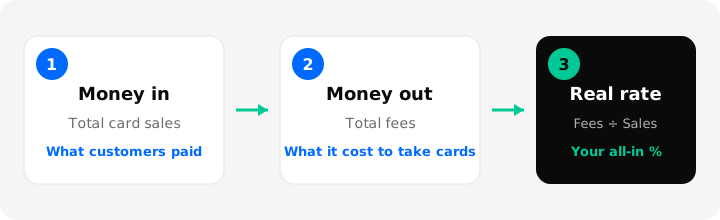
Before you dive into every code, find:
- Total card sales (gross volume for the period)
- Total fees (everything deducted for processing)
- Effective rate — total fees ÷ total card sales
Example: $20,000 in card sales and $600 in fees is a 3.0% effective rate.
That single percentage is your “all-in” cost. It’s more honest than any one line that says “discount rate 1.8%” while other fees sit lower on the page.
The fee names you’ll see most often
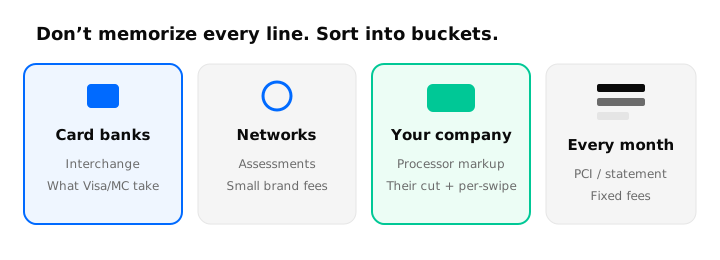
Statements vary by processor, but most traditional (interchange-plus or tiered) statements include some mix of:
Interchange
What the card brands / issuing banks charge. It changes by card type (debit vs credit, rewards, corporate). You don’t set this; your processor passes it through (or bundles it).
Assessments / network fees
Small brand/network fees on top of interchange. Usually a fraction of a percent, but they add up.
Processor markup
What your payment company charges on top — sometimes a clear per-transaction + percentage, sometimes buried in “discount,” “qualified,” or bundled tiers.
Authorization / per-item fees
Flat cents per swipe, tap, or keyed entry. Easy to miss if you only watch the percentage.
Monthly / statement / PCI / “service” fees
Fixed monthly charges that don’t scale with sales. On a slow month they hurt more.
Chargeback / retrieval fees
Fees when a customer disputes a charge. Separate from the disputed amount itself.
You don’t need to memorize every code. You need to know which bucket each line falls into — and whether your “low rate” ignored the buckets that actually cost you money.
Tiered pricing: why “qualified” looks cheaper than it is
Some statements sort cards into qualified / mid-qualified / non-qualified tiers.
- The rate they quoted you is often the qualified tier.
- Rewards cards, keyed-in payments, and some debit can land in more expensive tiers.
- Your effective rate ends up higher than the number on the sales sheet.
If your statement is full of mid- and non-qualified volume, that “great rate” was never the rate you were really paying.
Flat-rate pricing: fewer lines, clearer math
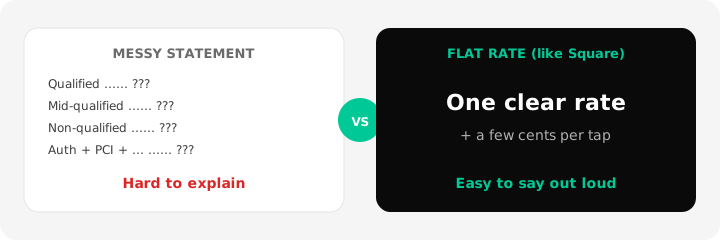
Some setups (including Square) use a simple published rate — for example a single in-person percentage + a few cents per transaction, and a different rate for online/keyed.
You still should:
- Confirm in-person vs online rates match how you actually sell
- Watch for hardware, software subscriptions, or add-ons if you use them
- Recalculate effective rate from deposits vs fees for one full month
The point of flat-rate isn’t “magic cheaper.” It’s readable. You can explain your cost in one sentence to a partner or bookkeeper.
A 10-minute monthly checklist
- Pull last month’s statement (or Square/report export).
- Write down total sales and total fees → effective rate.
- Circle any new fee names you didn’t see last month.
- Note chargebacks (count and fees).
- Ask: Did my mix of in-person vs online change?
- If something jumped more than ~0.2–0.3% effective with no obvious sales mix change, ask your rep to walk the statement with you line by line.
What “good” looks like for a local business
There’s no single perfect rate for every shop. A café with mostly debit and a contractor who keys invoices online will not look the same.
What is universal:
- You should be able to explain your pricing in plain language
- Surprises on the statement should be rare
- Someone local should pick up the phone when a line doesn’t make sense
That’s the LocalPay approach: Square’s transparent rates, plus a named local rep who will sit with your statement — not a ticket queue that pastes a FAQ.
What to do next
Don’t start with fifty fee codes. Start with effective rate, learn the main buckets, and treat mystery tiers as a red flag.
If you want a second set of eyes on your last statement, reach out to your local LocalPay rep. Bring the PDF. We’ll translate it into dollars and decisions — not jargon.
Talk to your local rep
Want a second set of eyes on your last statement? We’ll walk it with you — no jargon dump.